¶ Information Systems Architecture
¶ 1. Overview
This Application Architecture defines how LUNA Charts is structured at the application level. It describes the internal processing model, developer interaction boundaries, system layers, and architectural style used to ensure accessible, consistent, and predictable chart rendering.
LUNA Charts is designed as a declarative, component-based charting library with a controlled internal processing pipeline and strict input boundaries.
¶ 2. Architectural Style
LUNA Charts follows a:
- Declarative API model
- Component-based developer interface
- Black-box processing pipeline
- Opinionated and non-extensible architecture
¶ Key Characteristics
- Single entry point for developers via chart components
- Strict separation between input and internal processing
- Deterministic rendering behavior
- No plugin or extension system
- Accessibility and validation are enforced internally
¶ 3. Developer Interaction Model
Developers interact with LUNA Charts exclusively through a declarative component API.
¶ Public API
<BarChart /><LineChart /><PieChart />- (and other chart-specific components)
Each component has its own strongly typed data model.
¶ Responsibilities of the Developer
Developers are responsible for:
- Providing correctly structured data per chart type
- Using typed configuration models provided by the library
- Preparing and transforming data before passing it into the component
¶ Restrictions
Developers cannot:
- Modify internal rendering logic
- Override accessibility processing
- Inject plugins or extensions
- Interfere with internal pipeline stages
¶ 4. System Boundary Model
LUNA Charts exposes a strict system boundary:
¶ Allowed Inputs
- Typed chart components
- Structured data per chart type
- Configuration properties (themes, labels, styling overrides)
¶ Internal System Ownership
After input is provided, the system fully controls:
- Data validation
- Configuration resolution
- Accessibility enforcement (system-wide cross-cutting concern)
- Rendering process
- Fallback behavior
¶ 5. Internal Processing Pipeline
LUNA Charts processes all input through a deterministic pipeline:
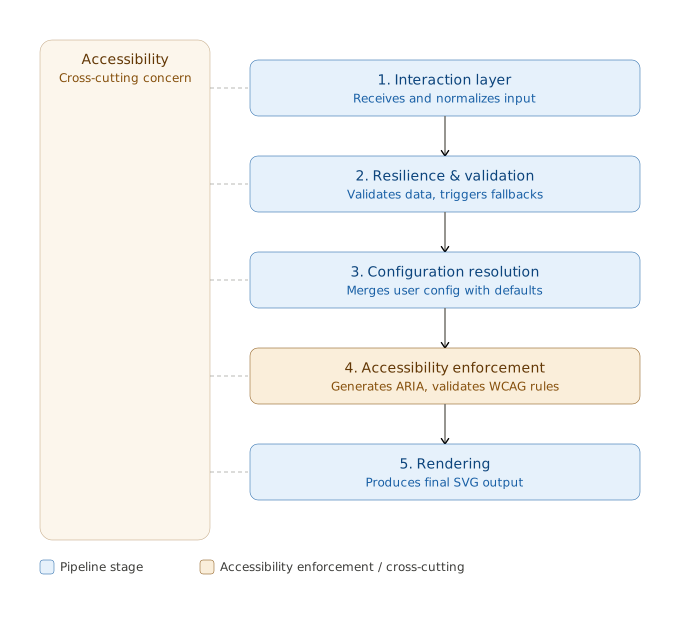
¶ 1. Interaction Layer (Entry Point)
Receives component input
Accepts data and configuration
Normalizes incoming parameters
¶ 2. Resilience & Validation Layer
Validates input data integrity
Detects missing or invalid values
Triggers fallback behavior if necessary
Emits warnings for developer feedback
¶ 3. Configuration Resolution Layer
Merges user configuration with default values
Resolves themes, labels, and styling parameters
Applies library-provided defaults when needed
¶ 4. Accessibility Enforcement Layer
Applies accessibility rules and guidance mechanisms intended to support WCAG-compliant chart implementations
Generates ARIA attributes
Validates known accessibility constraints
Provides runtime warnings and developer feedback
(Cross-cutting concern applied across all layers — see Section 4)
¶ 5. Rendering Layer
Transforms processed data into visual representations
Generates SVG or Canvas output
Produces final chart visualization
¶ 6. Chart Type Model
LUNA Charts uses explicit chart-type components:
<BarChart /><LineChart /><PieChart />
¶ Characteristics
- Each chart type has a dedicated internal rendering strategy
- Chart type selection is static and defined at component level
- No runtime switching of chart types
- Each chart type defines its own data structure
¶ 7. Cross-Cutting Concerns
¶ Accessibility (System-wide Concern)
Accessibility is implemented through a combination of type-safe APIs, validation mechanisms, default configurations, runtime warnings, and internal quality assurance processes.
It includes:
- WCAG compliance rules
- ARIA generation
- Accessibility validation
- Runtime and build-time checks
¶ Resilience & Fallback Behavior
The system ensures stability through:
- Default values for missing configurations
- Fallback labels for missing data
- Safe rendering under incomplete input
- Warning generation for developer feedback
¶ 8. Configuration Model
LUNA Charts provides a strongly typed configuration system.
Developers can configure:
- Themes (colors, contrast, styling)
- Labels and text overrides
- Chart-specific display options
- Accessibility hints (optional)
Configuration is merged with system defaults during the processing pipeline.
¶ 9. Technology-Agnostic Design
This Application Architecture does not assume a specific frontend framework but is compatible with modern web ecosystems such as:
- React
- Vue
- Angular
- Web Components
The API is component-based but conceptually framework-agnostic.
¶ 10. Key Architectural Decisions
- Component-based declarative API is used instead of pure DSL or JSON input
- System uses a single controlled entry point for all interactions
- Internal pipeline is fully deterministic and not externally modifiable
- Accessibility is enforced as a core system responsibility
- No plugin or extension mechanisms are provided
- Chart types are explicitly defined and not dynamically extensible
¶ 11. Trade-offs
¶ Advantages
- Strong accessibility guarantees
- High consistency across all charts
- Excellent developer experience
- Predictable behavior
- Reduced implementation complexity
¶ Limitations
- Limited extensibility for custom chart types
- Reduced low-level control over rendering
- Strict API constraints for developers
- No plugin ecosystem support
¶ 12. Evolution Note
No structural changes were introduced in this document during this iteration. This architecture remains fully aligned with:
- Architecture Vision (Phase A)
- Business Architecture (Phase B)
- Information System Architecture (Phase C)