¶ 1. Problem Statement
Modern web applications are increasingly required to meet accessibility standards such as the European Accessibility Act (EAA) and WCAG 2.2 guidelines.
However, implementing accessible data visualizations remains a complex and underrepresented area in frontend development. Many developers lack specialized knowledge in accessibility design patterns, especially for chart components such as bar, line, or pie charts. As a result, accessibility is often added late, inconsistently, or not at all.
¶ 2. Objective
LUNA Charts aims to provide a reusable, developer-friendly charting library that enables the creation of accessible, WCAG-oriented data visualizations for web applications.
The primary objective is to reduce the complexity of implementing accessibility in charts while maintaining flexibility for customization and integration into modern frontend stacks.
¶ 3. Target Audience
The primary stakeholders of LUNA Charts are:
- Frontend developers integrating chart components into web applications
- Full-stack developers building data-driven products
- Teams responsible for accessibility compliance in digital products
Secondary stakeholders include:
- UX/UI designers concerned with accessible data representation
- Accessibility specialists reviewing compliance with WCAG standards
- End users, including users with visual, cognitive, or motor impairments
¶ 4. Benefits
LUNA Charts provides the following benefits:
- Simplifies the implementation of accessible data visualizations
- Reduces the need for deep accessibility expertise in development teams
- Promotes consistent WCAG-aligned chart behavior across applications
- Improves development speed by providing reusable, standardized components
- Enhances end-user accessibility for data-driven interfaces
- Supports regulatory compliance with accessibility requirements
¶ 5. Scope
LUNA Charts is a frontend-focused charting library providing reusable components for accessible data visualization.
It is further defined as a closed system with a strictly controlled input boundary and deterministic internal processing pipeline (see Section 8.4).*
¶ 6. Architecture Principles
The following principles guide all architectural decisions in LUNA Charts. They apply across all ADM phases and serve as the basis for evaluating design options, resolving conflicts, and maintaining long-term consistency.
| ID | Principle | Statement | Rationale |
|---|---|---|---|
| P01 | Accessibility by Design | Accessibility is a core requirement of every component, not a feature added after the fact. | Aligns with the EAA and WCAG mandate; prevents costly rework in later development stages. |
| P02 | Framework Agnosticism | LUNA Charts must not introduce tight coupling to any specific frontend framework. | Maximizes adoption potential across React, Vue, Angular, and Web Components ecosystems. |
| P03 | Developer Experience First | Every API decision is evaluated primarily by the effort it imposes on the integrating developer. | Adoption depends directly on integration speed and ease of use. |
| P04 | Open Source by Default | LUNA Charts is developed and maintained as an open-source project. | Builds community trust, enables external contributions, and ensures regulatory transparency. |
| P05 | Standards over Convention | Where open standards exist (WCAG, ARIA, WAI-ARIA), LUNA Charts follows them over proprietary patterns. | Ensures long-term maintainability and compatibility with assistive technologies. |
| P06 | Lightweight by Design | The library actively minimizes external dependencies and bundle size. | Prevents performance regressions in integrating products. |
| P07 | Separation of Concerns | Visual rendering, data processing, configuration resolution, and cross-cutting concerns are clearly separated. | Improves testability, predictability, and architectural clarity. |
¶ 7. Success Criteria
The success of LUNA Charts is primarily measured by:
- Adoption rate among frontend and full-stack developers
- Integration into production-grade applications
- Reduction of accessibility-related implementation effort in charting
- Positive developer experience and ease of integration
¶ 8. Change Log
During subsequent TOGAF Architecture Development Method phases (Business and Application Architecture), the following refinements were made:
¶ 8.1 Accessibility Model Refinement
- Accessibility was reclassified from a conceptual "Accessibility Engine" to a system-wide cross-cutting concern
- Accessibility is enforced across multiple layers:
- Default value handling (design-time)
- Validation and checks (build-time)
- Runtime warnings and safeguards
(See original Section 1 + Section 6 — refinement of internal architecture interpretation)
¶ 8.2 Architectural Structure Shift (Component → Pipeline Model)
- The system architecture was refined from a component-oriented view to a deterministic processing pipeline model
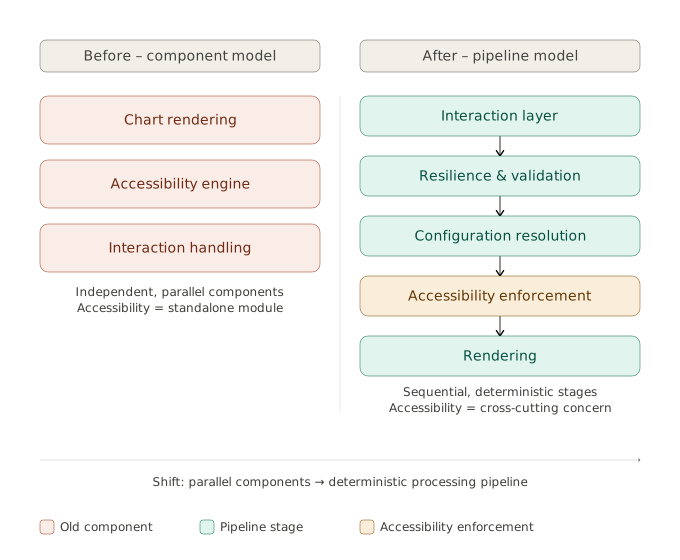
Architectural Structure Shift
- Internal processing is now defined as sequential stages:
- Input / Interaction
- Validation / Resilience
- Configuration Resolution
- Accessibility Enforcement
- Rendering
(Impacts Section 5 Scope and Section 6 Principles P07)
¶ 8.3 Developer Interaction Model Clarification
- The developer interaction model was clarified as a component-based declarative API
- Developers interact via strongly typed chart-specific components such as:
<BarChart /><LineChart /><PieChart />
- Each chart type defines its own strict data model
(Refines Section 2 Objective and Section 3 Target Audience assumptions)
¶ 8.4 System Boundary and Extensibility Constraint
- The architecture was explicitly defined as a closed system
- No plugin system or extension points are provided
- Internal pipeline stages cannot be modified or extended by external developers
- Developer interaction is strictly limited to input and configuration at the system boundary
(Refines Section 5 Scope and Section 6 Principles P07)
¶ 🔎 Summary of Changes in This Document
The following sections were updated compared to the original version:
- Section 5 (Scope) → clarified system boundary model
- Section 6 (Principles) → refined separation of concerns wording
- Section 8 (Evolution Note) → fully introduced and structured architectural evolution